
The Blueprint
Art & Culture
How we replace GEMA and GEZ.
We need art and identity in order to understand ourselves. The mental stimulation through music, books and images educates us tremendously. But how do we finance culture in an environment without capitalism? How can GEMA and GEZ be replaced? Where do we get the infrastructure and what do we pay for it with?
Let us assume that we pay 5 euros a month for art and culture. These 5 euros are divided into basic provision and self-determined content. Of these 5 euros, one part goes into a kind of basic-provision fund, for artists who are just starting out, supporting them until they can stand on their own feet. Another part of the 5 euros would be for the basic provision and serves to maintain the infrastructure, and the rest we use to make publicly relevant content available, such as information, education and medicine. Then the content can be accessed at any time free of charge and free of advertising.
The deeper change
Basic assumptions with 20 million participants and a 5 euro contribution: Split as described:
- 20 % basic-provision fund --> Source of income A
- 20 % infrastructure
- 10 % public content
- 50 % self-determined content --> Source of income B
Type 1: Emerging artist (music / illustration / film)
- Status: early 20s to 30s, no large reach yet
- Source of income A – Basic-provision fund
- Admission to a funding program (time-limited, e.g. 24 months)
- 1,000 € / month base amount
- 12,000 € / year
- Condition:
- regular publication
- disclosure of the works
- no exclusive contracts
Result:
- Rent & food secured
- Time for development
- no dependence on click numbers
Source of income B – Self-determined allocations
- e.g. 1,500 supporters
- each person gives on average 1 € / month
- → 1,500 € / month
- → 18,000 € / year
Total income Type 1
- Basic fund: 12,000 €
- Direct allocations: 18,000 €
- = 30,000 € / year gross
Type 2: Established indie artist (podcast, band, documentary)
- Status: small, stable community
- Self-determined content (main source)
- 15,000 supporters
- Avg. 1.50 € / month
- → 22,500 € / month
- → 270,000 € / year
Deductions:
- Social insurance
- Production costs
- Team (editing, technology)
- Net:
- approx. 90,000–120,000 € / year for the artist
Additional:
- Project funding (e.g. album, film)
- one-time 20,000–50,000 €
Type 3: Niche artist (e.g. experimental art, minority languages)
- Status: small reach, high relevance
- Basic-provision fund (permanent, but evaluated)
- 800 € / month
- → 9,600 € / year
Direct allocations:
- 500 supporters
- Avg. 1 € / month
- → 6,000 € / year
- Total income Type 3
- ~15,600 € / year
5. Important safeguards
So that it does not tip over:
- Cap per artist (e.g. max. 0.2 % of the total fund)
- Transparent figures
- time limit on the basic funding
- no anonymous large allocations
- Anti-gaming rules
No tax, but membership with a say in decisions.
The model shifts from compulsory contribution and “Who runs the most advertising?” to “Does the art mean something to people?” Artists no longer live from dependence and self-exploitation but from relationship, relevance and expressive power.
No wealth, but viable, without side jobs.
- no constant self-marketing
- no algorithm dependence
- no unpaid work
- no existential fear
Today only possible with advertising, sponsoring or platform dependence
- plannable base income
- no compulsion to produce clickbait
- direct relationship with the audience
- creative willingness to take risks
Artists publish directly.
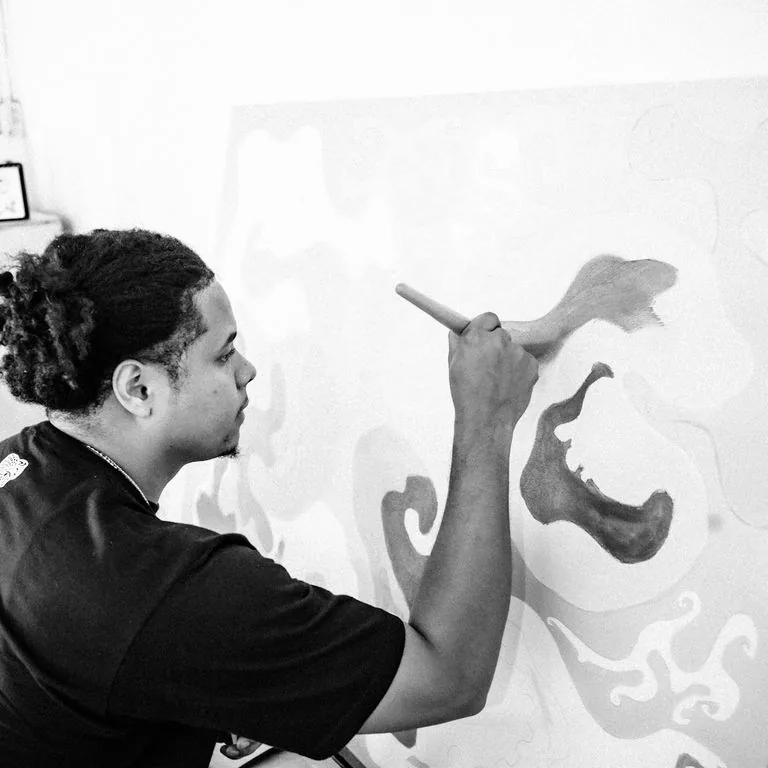
Artists must be able to create art without a contract; they must be able to work without a contract. Contracts with record labels, advertising agencies or book publishers are no longer needed. You like a guitarist. You like a picture? A sculpture or a book? Well - you have 3 euros left over. With them you can transfer one euro to the guitarist. If the guitarist now has 2,000 followers who transfer one euro to him per month, he would already have a livelihood. Now two euros of the three euros are still left. With them, other artists and cultural workers can be paid. As you see fit. Conversely, this means that artists publish their works directly and without detours. If, after 5 years, the artist cannot support themselves with their art, their art must remain a hobby for the time being.
Today we all pay – but decide nothing. This model lets us pay less – and finally decide for ourselves. With this conceptual construct for financing artists, GEMA and GEZ would be obsolete. Unwanted content would be immediately overridden and there would be no advertisements. In addition, it is ensured that art comes into being because artists feel the inner drive to write, to sing or to paint. An artist will no longer do it for the money, he will do it for the sake of art.
Structures for Creative Freedom, Diversity and Independent Art
Art and culture do not arise on command. They thrive where people can think freely, experiment, fail and go new ways. That is why Zivilisation 0 creates the conditions for creativity to grow out of itself.
Artistic freedom is an inalienable fundamental right. Every form of artistic expression is protected as long as it respects the freedom and dignity of other people. Neither state institutions nor economic interests determine which art may come into being or which topics are socially desired.
The financing of art follows the principle of independence. Public culture funds are managed transparently and awarded by plurally composed, regularly rotating committees. Different styles, perspectives and social positions receive the same chance of funding. Art is not judged by political proximity, economic benefit or majority taste.
Every region has freely accessible culture and creative spaces – studios, workshops, stages, music studios and digital media centers. These places are open to professional artists just as much as to people who want to rediscover their creativity. Culture thereby becomes part of everyday life and not the privilege of a few.
Diversity is a natural consequence of open structures. Different cultural backgrounds, generations and ways of life enrich one another and create a lively cultural landscape. Even uncomfortable, experimental or controversial art has its place, because social progress often arises where existing views are questioned.
Cultural heritage is preserved without limiting innovation. Traditions and new forms of expression complement one another. Past and future together form the cultural wealth of a society.
In Zivilisation 0, art is neither a commodity nor an instrument of political influence. It is an expression of human freedom, a space for insight, criticism, beauty and hope. A society that protects independent art also protects its ability to question and develop itself anew again and again.
FAQ
Culture & Information Fund
1. What is this, actually?
The Culture & Information Fund is a voluntary pilot model in which citizens pay 5 € a month in order to:
- finance art & culture fairly
- make independent information, education & knowledge freely accessible
- have a say in which content is supported
2. Is this a new tax or compulsory levy?
No.
- The pilot is voluntary (opt-in)
- Participation can be ended at any time
- It is not a tax, but
- a membership with a say in decisions
3. Why should I pay if I hardly use culture?
Because culture – like education or roads – is public infrastructure.
In addition:
- You decide on 50 % of your contribution yourself
- Public content (news, education, medicine) is free for everyone
- No one forces you to finance particular content
4. What exactly do the 5 € go to?
Per month:
- 1 € basic security for artists (start & livelihood)
- 1 € technical infrastructure (platforms, archives, accessibility)
- 0.50 € public content (journalism, education, medicine)
- 2.50 € you allocate yourself to content or artists of your choice
5. How do I decide on my share?
Via a transparent platform:
- monthly or yearly
- with a click
- changeable at any time
- You see exactly:
- whom you give money to
- how much
- for what
6. Do artists simply get money without performance?
No.
- Basic funding is time-limited
- Self-determined funds exist only with real support
- No click numbers, no advertising – relationship counts
7. Doesn't this promote mediocrity?
On the contrary:
- Today algorithms reward loudness
- Here, significance to people decides
- Niches, minority languages and experiments have chances for the first time
8. Can't big stars skim off the system?
No, because:
- There are upper limits per person
- No anonymous large payments
- Transparent distribution
- Focus on diversity instead of mass
9. What happens to ARD, ZDF and the GEZ?
Nothing is abolished
- Public broadcasters are welcome to contribute content
- Archives become more freely accessible
In the long term:
- The broadcasting fee could gradually receive allocations
- Tax financing phases out
10. Who controls all of this?
- A foundation independent of the state
- Citizens' councils (chosen by lot, time-limited)
- Public accountability reports
- Open-source technology
- No ministerial control
- no party control.
11. Isn't this vulnerable to fraud?
Less than today's systems:
- No click or streaming manipulation
- Clear rules & caps
- Public figures
- Community reports
- Abuse is made harder, not rewarded.
12. Why not simply reform GEMA and GEZ?
Because:
- both systems have grown historically and are hard to reform
- they allow little participation in decisions
- Transparency is lacking
13. What do I personally get out of it?
- no advertising
- free, reliable information
- more diverse culture
- direct impact of your support
- a stronger public debate
14. What does it cost me compared with today?
5 € / month
- Broadcasting fee today: 18.36 € / month
- no cable connection
- Streaming subscriptions often in addition
👉 Less money, more influence.
15. What happens if the pilot project fails?
- Then it is ended.
- No permanent obligation
- All results public
- No financial risk for participants